European Christian Identity and Self-Secularization

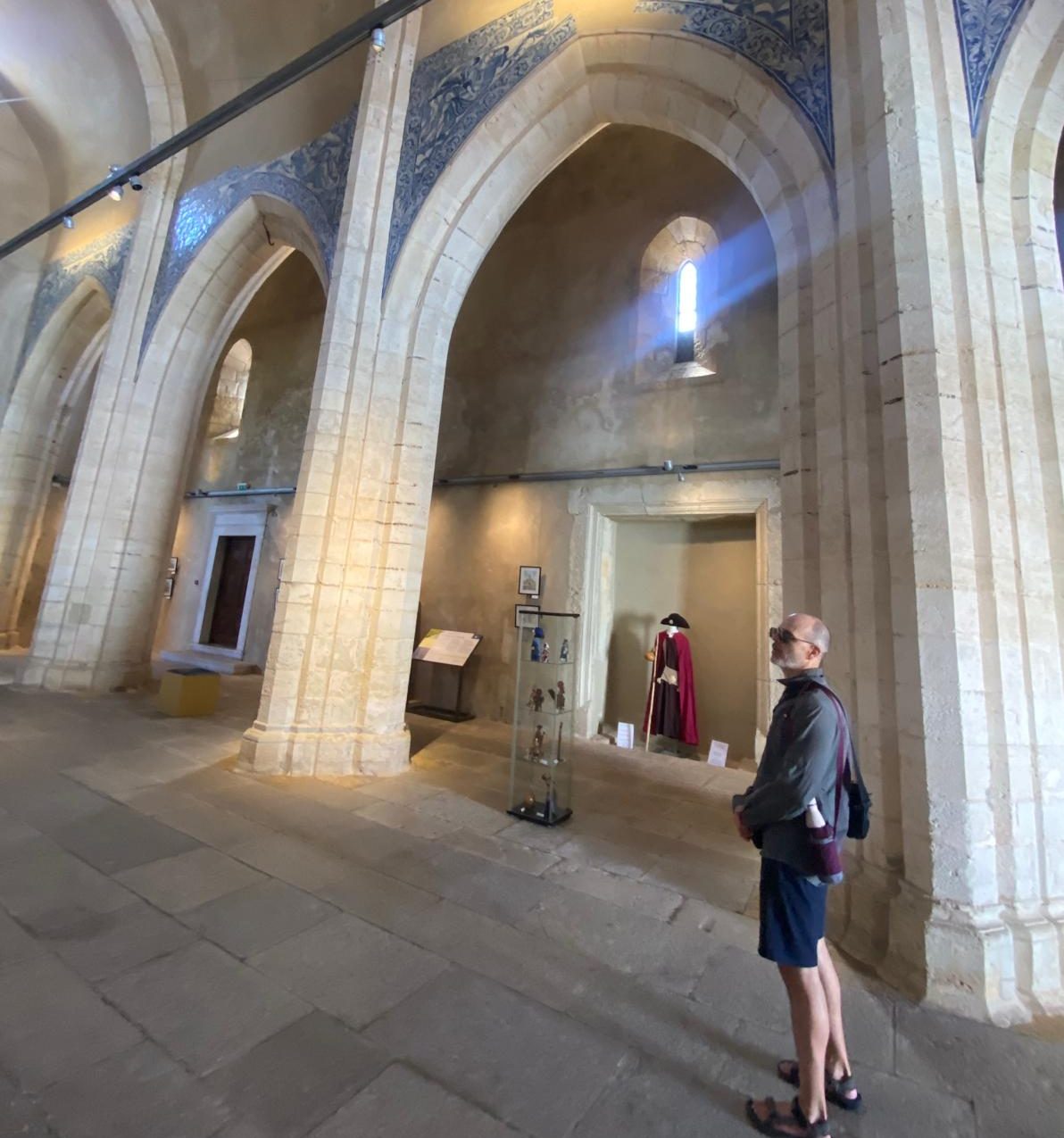
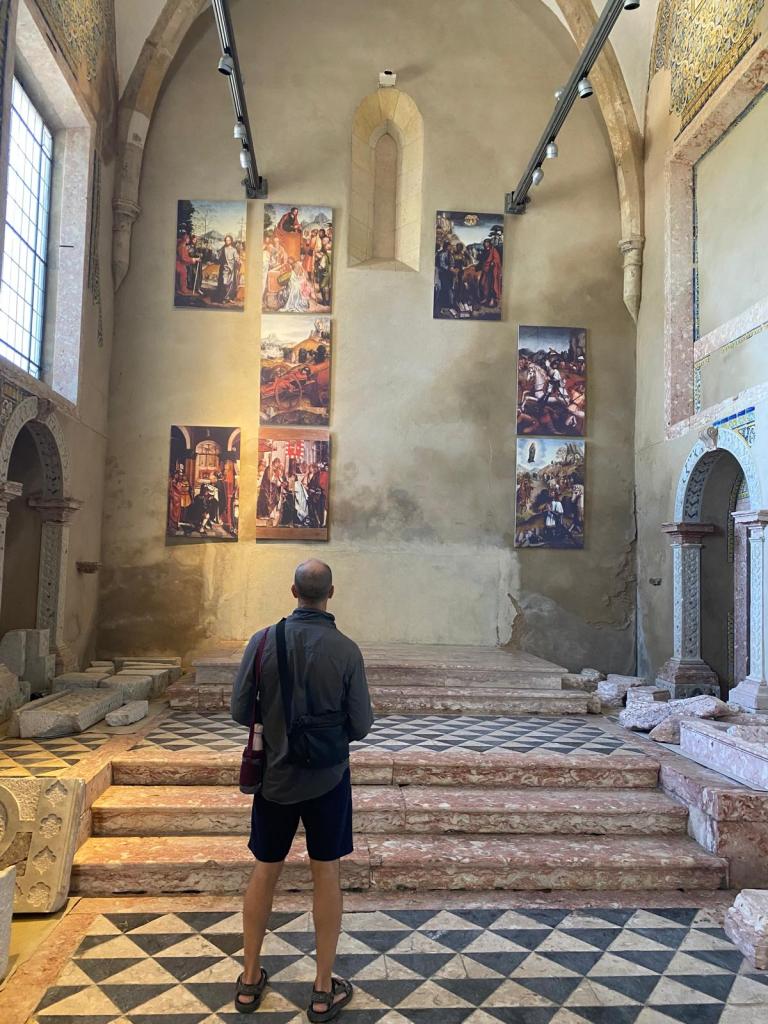
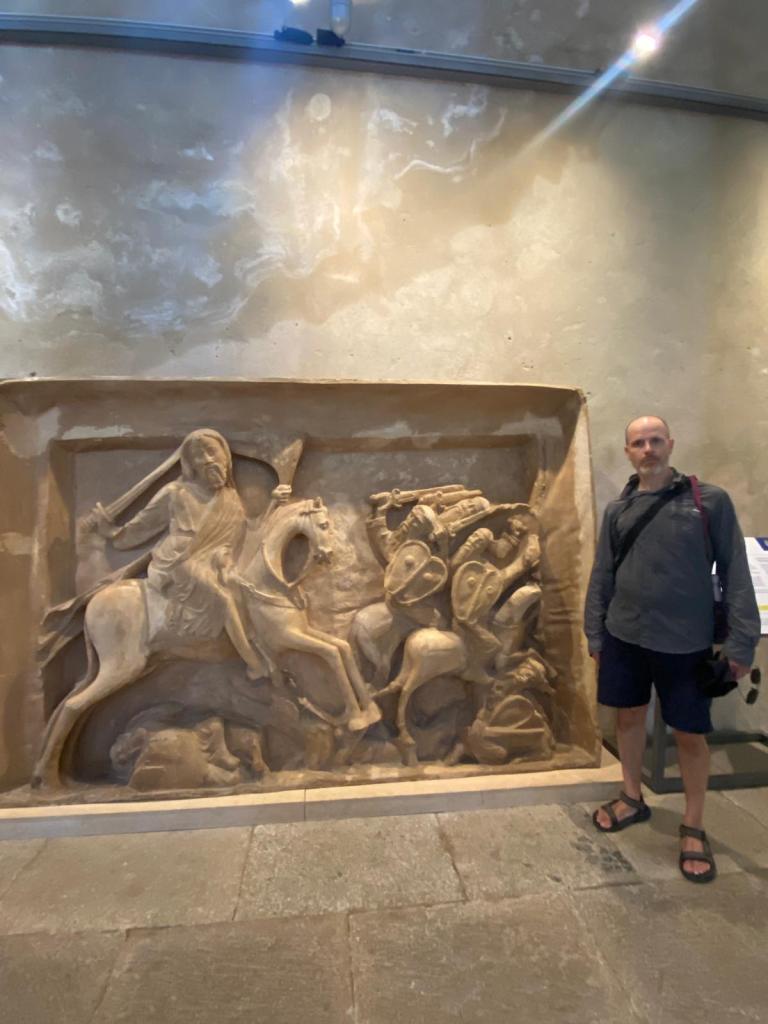
I believe that understanding the ancient history of Portuguese faith and culture is key to contributing to the work of the Spirit in this ancient land. Part of my field work for promoting reconciliation between Catholics and Protestants is to understant the history. My wife Kati and I recently visited the Castle of Palmela on the Peninsula of Setubal on the other side of the Tagus river. Dating from the 310 b.c., the Castle was built by the Romans and subsequently conquered by the Visigoths and the Moors. The site is a rich source of data on the conquest of the Moors and reconquest of Christian crusaders. The Moors built the original fort on the hilltop, which has been excavated and can be toured. A vast amount of Moorish arifacts are on display. The crusader spirit of the Spainish and Portuguese Christian armies would give rise to the crusades in the Holy Land. Islamic civilization dominated the Iberian peninsula lasted for 8 centuries, and is one of the reasons most Spanish and Portuguese see Catholic faith as patriotic and essential to their national identity. Kati was able to find the crest of her maternal family name Gonçalvez.
In a land so deeply rooted in Christianity, but also in religious wars, we pray that the ancient church of Christ can be continually renewed. The biblical vision for renewal and revival is not one of obliterating or ignoring the past, but of repentance and restoration, as the prophet Isaiah wrote “In repentance and rest is your salvation, in quietness and trust is your strength, but you would have none of it” (Is. 30:15). In so many nations the church seeks to vindicate itself against the accusations of those who focus only on the dark side of Christian history. But through repentance and loving witness the church can find new strength even in extremely secular Western Europe. 

Protestand and Catholic – who God used to bring the transforming values of Christ’s kingdom. But as the Muslim world often sees Christ as representing Western violence and enmity, we must pray for the restoration of the gospel message of peace, forgiveness, and reconciliation of all nations with the Heavenly Father. 

French Protestant sociologist Oliever Roy (2024, https://youtu.be/IAl6aOePZsQ?si=3XiCGBgQONS1NefK) argues that many Christian populists in Europe today are children of the 60s cultural revolution who don’t adhere to religious practice or belief but only use Christianity as an identity factor in juxtaposition to minorities such as Muslim immigrants. Roy argues that since the 1990s these populists blame groups like Muslim immigrants for de-Christianizing Europe. But Roy’s research indicates that the de-Christianizing of Europe resulted primarily from Enlightenment thinkers such as Descartes and Kant who tried to secularize Christian morals rather than coming up with new morals. Secularization of education was based on an idea of universal ethics that should not be questioned. Protestants we’re first to legally impose Christian ethics such as making homosexuality illegal. Both Protestants and Catholics banned abortion but this was only much later, lasting until the 1960s. Until the 1960s, the Christian identity of Europe wasn’t a concern because secularism preserved much of Christian ethics as the basis for law and education. The counterculture movement of the 60s was not an anti-religious. From the 60s to the 80s, the laws changed in Europe to accommodate the sexual / cultural “revolution” but there wasn’t any real political revolution. The Protestants self-secularized while the Catholics focused on resisting cultural changes on sexuality and family. Roy describes how populist politicians sinde the 1990s have said they represent Christian culture while supporting positions att odds with traditional Christian views on marriage, abortion, love of neighbor (immigration), etc.  

As the church in Europe is challenged with finding its role within secular nations, our prayer is that Christians will be both relevant as well as distinct from the systems of the world which are always a mixture of good and evil. Our prayer is that Christians seek the flourishing of the nations where they are citizens while understanding the Christ’s vision for the coming of the kingdom, distinct from the hegemony of any human institution.

Recently we also visited a popular festival in a rural village an hour north of Lisbon. This was a deep experience of rural Portuguese culture. A particularly insigtful moment was when the parish priest said a blessong over all the visiting family members who were working and living abroad. It helped us understand the deep connection the Portuguese maintain with their ancient agricultural communities while many work overseas. Many in the West feel that monetary gain and freedom from societal norms will ultimately prove the most powerful influences in modern society. But in Southern Europe, we have seen the enduring values of land, church, and ancestry. The less economically powerful countries on the perifery of Europe – sometimes prejoratively referred to as the PIGS (Portugal, Ireland, Greece, and Spain) have exported their young people for generations to work in richer nations. On a trip to Wengen, Switzerland years ago I read the names of workers who had died digging a passage way through the alps in the 1920s, all of them Italian, Spanish, and Portuguese. On our visit to a small Portuguese village, it was a privilege to witness how the traditions and affections of traditional Southern European life are preserved. 

http://southernbellecrochet.com/free-pattern-mini-prayer-cloth/

Challenging Common Notions Regarding Faith Today

Church is for the Disenfranchised of Society?

According to sociologist Nancy T. Ammerman (2015, https://youtu.be/xl9qYKcfWUo?si=d6H0-A1V_2-3KBO8), a key shift in the sociology of religion has been the blurring of boundaries that traditionally confined the field. Increasingly, sociologists are exploring how religion is manifest in diverse spheres of daily life. Some findings contradict common notions regarding religious affiliation and practice in the Western world. For example, religious vibrancy is often attributed to Evangelical Pentecostalism that attracts the poor and disenfranchised communities of large urban centers. However, Ammerman’s research indicates the opposite – that the poor and disenfranchised are the majority of those who don’t attend regular worship services in the U.S. On the contrary, most churchgoers tended to be upstanding enfranchised members of society.

Together with Spanish sociologist Jose Casanova, Ammerman’s research found that most Americans who leave their religious tradition do so because they don’t belong not because they don’t believe (Ammerman, 2022, https://youtu.be/RAgd4QmVWKA?si=6OjKExySg-hqFgTO). This reinforces the evidence that religious faith is often higher among the more educated because they feel they belong to society, including its religious expressions and institutions.

Spirituality Thrives without Community and Tradition?

Ammerman also researched religious “nones” in the U.S. (2016, https://youtu.be/W-uOims2A0A?si=RP3j4JaCeoldxvW0), the term referring to people who have religious beliefs and practices that are not expressed in the context of organized religion. Only a tiny percentage of these religious nones (RNs) are atheists. The biggest factors for the growth of the RNs since the 1980s was being raised by parents who were also RNs as well as the rise of the “moral majority” Evangelical political culture, which many credited with their decision to leave church. A common notion associated with the RNs is that vibrant individualized spiritual practice often thrives without association with any faith tradition or community. Ammerman found that doing so is very difficult and that community and tradition are extremely helpful for the development and maintenance of religious practice. Many RNs end up joining religious communities, and most of them are drawn by the experience of collective worship – the experience of connecting with God and community. Particularly attractive to RNs is the opportunity to converse with others in church about their faith. Ammernan also described a large category of marginal or “liminal” RNs that move in and out of religious communities and traditions in a cyclical pattern never developing roots. 

Spirituality Thrives Where there are Convincing Rational Arguments for Faith?

German Catholic sociologist Hans Joas (2020, https://youtu.be/BcuyrfhQ76Y?si=Eohb1T2UvT1GZGx0) argues that values develop from human experience, in contrast to the view that in modernity values develop from rational discourse. Joas cites the Holocaust, which came to be seen as evil not by rational discussion but historical experience. In contrast to the view that the modern era is disenchanted, Joas argues that universal human morals emerge through a process, concepts such as humanity as a common race across the earth with shared essential qualities. Joas sees a global genealogy of moral universalism, in which the individual’s moral values cannot be explained by the tradition they were raised in. Rather, individual’s values are shaped by paradigm-forming experiences. Joas argues that enchantment, which I would describe here as the consciousness of the spiritual, is a constant cyclical re-emerging human phenomena throughout human history and very much present today. In contrast to the secularism hypothesis, Ireland, Poland, Croatia, and southern Germany are examples of the pervasive relevance of religious faith and practice (Joas, 2002, https://youtu.be/N_f-MF19GSs?si=tL_xapiSi0AARfgS).

Implications for Faith in the Modern West

In this brief text, I have cited some interesting trends in the sociology of religion. As a Christian living in Southern Europe, I am encouraged to see such evidence of desire for God in the modern Western world. It has also been my experience that developing and maintaining the Christian life – a relationship with God and participation in His kingdom – is highly impeded by a lack of community. The body of Christ is where we experience the collective reality of Christ’s kingdom. Jewish philosopher Emmanuel Levinas held that ethics precludes ontology in philosophy (Zoloth, 2024, https://youtu.be/nCT_nS3z1aA?si=sCARFsRjXl-5VqUz). By this he meant that ethics can only be understood in the context of community. Enlightenment modern attempts at totality deny the particularity of the individual. Levinas argued that the encounter between the individual and God was the foundation of ethics, rooted in Torah. Levinas say this encounter as always involving three interlocutors: God, the individual, and the other. 

These trends in sociology of religion reveal the continued relevance of religious faith and practice. We don’t live in a time of increased irrelevance or marginality of faith and devotion. Even in the West, we are surrounded by a vast sea of individuals who seek the answers and experiences that we Christians have found in Jesus Christ and his church. 

References

Ammerman, 2015, https://youtu.be/xl9qYKcfWUo?si=d6H0-A1V_2-3KBO8

Ammerman, 2016, https://youtu.be/W-uOims2A0A?si=RP3j4JaCeoldxvW0

Joas, 2002, https://youtu.be/N_f-MF19GSs?si=tL_xapiSi0AARfgS

Joas, 2020, https://youtu.be/BcuyrfhQ76Y?si=Eohb1T2UvT1GZGx0

Zoloth, 2024, https://youtu.be/nCT_nS3z1aA?si=sCARFsRjXl-5VqUz

When God Leads Through the Squeeze

squeeze

“17 So Isaac moved away from there and encamped in the Valley of Gerar, where he settled. 18 Isaac reopened the wells that had been dug in the time of his father Abraham,… 22 He moved on from there and dug another well, and no one quarreled over it. He named it Rehoboth,[e] saying, “Now the Lord has given us room and we will flourish in the land.” (Gen. 26)

Sometimes I wonder why I’m not more in tune with the prophetic. I was raised in a Christian community that emphasized the desire of God to lead our lives daily. My grandmother Joy used to use the example of Jesus saying that we live by the daily word of God to us just as we need bread for food. So true.

But we all experience how circumstances are also an undeniable part of the revelation of God’s will for our individual lives. This is true in every Christian’s life, but perhaps more for some than others, maybe we can call these the hard-headed ones.

Some of us just seem to have so much drive in us that we choose a direction in life, run after it like crazy, and turn a deaf ear to the voice of God. Many of us do this inadvertently, but it happens. Then it remains to God to remove His Grace and wait for us to run out of steam. God’s grace comes in so many forms – provision, opportunity, inexplainable joy, anointing, etc – and when it’s gone we know. You just get yourself into a situation that you can’t handle anymore. You’re in too deep and now you can’t even be what you need to be to those who depend on you.

Our sense of self-sufficiency is such an illusion. I think that missionaries have the privilege of experiencing this cross-culturally. It’s no exaggeration to say that the past year and a half that I’ve been back in the U.S. is just as hard of a transition as when I moved to Brazil in 2003. Kati and I were talking about how it feels to transition like this – new neighborhood, new church, new work, new weather, food, etc. I tried to put how it felt to me saying, “It feels cold”. We take for granted the warmth of the familiar – how it makes us feel significant, in control, and comfortable.

This is what God has to remove so His more strong willed children can be squeezed into the fulfillment of His promises lives. At these times we can cry out and say God make it quick, I want the transition to be over… please. But many of these turbulent souls are those the Father has chosen to lead others. The storm that rages within them can be an evergreen source of energy to inspire others towards the building of God’s kingdom.

So if you are like me, join me in praying that the Lord will continue to bless us in times of transition and teach us all we need to learn. Instead of praying that the transition be over sooner, let’s pray that we don’t miss anything the Father wants to teach us in the interim.

Rise of the Religious “Nones”

Sociologist of religion Linda Woodhead has done important work on the rise of the religious “nones”, i.e., those who claim no affiliation with any organized religion (Woodhead, 2017). Her reserach demonstrates that increased secularization in the UK is not due mostly to adults walking away from their religious traditions. The greatest demographic source of the rise of the religious nones is teenagers raised in religious homes that opt to not follow their parents’ religion.

Many nones do attest to some form of spiritual practice in their daily lives. It is interesting to note which form of spiritual practice they are most averse to. Think of what spiritual practices are most common – prayer, scripture reading, pilgrimage, worship, etc. Woodhead’s research indicates that attending public worship of some other form of formal gathering is the most unpopular spiritual practice among religious nones.

I found this fascinating – why is it that the UK population is increasingly averse to attending formal religious gatherings but still widely practices prayer, scripture reading, and meditation?

I love going to my local church, so much of whose ritual connects me to experiences rooted in my childhood. I have lived long-term on three continents as a missionary but I always found a local Christian community I grew to love. But I recognize that my faith journey really began in earnest with a radical conversion experience in my late teens. I can’t imagine myself ever having found interest in local church attendance if it wasn’t for the life crisis and conversion experience I had in my youth. It was during that formative time that I came to understand why people are drawn to faith communities.

This isn’t to say that I never miss a Sunday service. There have been periods where it took my wife and I months, even years to finally find a church we could call home. But I wonder how Christians like myself can help make the curch a place people want to come to in contexts like Western Europe.

References

The Van Leer Jerusalem Institute. (2016, December 15). The Growth of “No Religion” — Secularisation but Not as Predicted | Prof. Linda Woodhead [Video]. YouTube. https://www.youtube.com/watch?v=HC-9hgBtwgM

Woodhead, L. (2017). The Rise of “No Religion”: Towards an Explanation. Sociology of Religion, 78(3), 247–262. Atla Religion Database with AtlaSerials. https://doi.org/10.1093/socrel/srx031

Lessons from Latin America on Secularism and Religious Pluralism

Towards an Ecumenical Vision?

Escobar (2012) describes the Crisis of Christendom in Latin America during the 20th century in which “vigorous minorities committed to evangelize” have challenged the Catholic status quo (p. 175). Dillon (2015) describes a similar situation in the U.S., where religious affiliation in the U.S. has declined in its “social desirability, or, and, in the actual relevance of religious affiliation” (p. 346). Although the historical foundations of US-America and Latin America are different, they share the common experience of a decline in Christendom. The first wave of challenge to Catholic supremacy in Latin America came with elites who favored the influence of Protestant missionaries as a means of promoting democracy and pluralism (Escobar, 2012, p. 176). The second challenge to the Christian status quo in Latin America came through the growth of Pentecostals, especially among the poor. Escobar (2012) describes Pentecostalism as “a movement coming ‘from below’, with its own religious and social dynamism and great expansive power” (p. 178). The rise from 5% to 15% of the US-American population affirming Pentecostal affiliation (Jacobsen, 2015, p. 208-9) since the 1950s shows the dynamism of this movement in that nation as well. 

The growth of Protestantism in Latin America during the second part of the 20th century was part of the larger phenomenon of a “massive exodus” from the Catholic Church whose centuries old form was “unable to cope with the challenges of the fast pace of social change” (Escobar, 2012, p. 177). And although the Catholic Church tried to these demands, such as with an emphasis on the marginalized poor, the poor themselves opted for Pentecostalism (Escobar, 2012, p. 178). Jacobsen (2015) describes the waves of growing Pentecostalism in US-America as reflecting the “increasing emphasis placed on experience instead of theology in almost all American churches” (p. 209). 

The growth of Pentecostalism in Latin America and the Catholic church’s response indicates the nuanced approach needed when Christianity attempts to follow the culture. While some adjustments of theology and practice have been fruitful throughout church history, some have not. Another way to view the matter of adjusting to culture is to be realistic about the results that may come. Whereas some Catholic faithful welcomed the new focus on the poor, others still found it to be too institutionally centered. This is perhaps an example of where a particular church must realize that its attempts at contextualization cannot impede people from opting for another church’s approach. An ecumenical vision that accepts God’s work through the diversity of Christian expression helps the different churches avoid discouragement and competition. 

Lessons from a Marginalized Christianity

The trend in US-America shows a different type of individualism since the 1960s expressed in a “culture of freedom and critique rather than of conformity and deference to external authority” (Dillon, 2015, p. 351). And more recently, the millennial generation has been described as “a generation of tinkerers” that adhere to a “mosaic of diverse beliefs and practices that is characteristic of the religiously affiliated and non-affiliated” (Dillon, 2015, p. 354). Particularly among younger US-Americans, the preference to be called spiritual than religious or to embrace double belonging to multiple religions indicates a “newly diverse and spiritually fuzzy landscape” (Jacobsen, 2015, p. 212). 

The challenge of the Christian status quo is present in Europe, North and South America regarding Catholic and Protestant opposition to same-sex relations (Dillon, 2015, p. 357-8). In contrast, although abortion attitudes vary much within the US-American Christian population, they have proven to be “highly stable over time” showing little variation among generations. Dillon (2015) interprets this phenomenon as indicating that “moral issues raise moral and value questions for individuals irrespective of religious identity and affiliation status” (p. 361). 

It seems that the Latin American Christian situation can inform the similar US-American situation of reduced centrality of Christianity in culture and society (Dillon, 2015, p. 363). There are significant demographic differences, such as the Latin American division between rich and poor versus the US-American fragmentation of diverse ethno-political interests. But the Latin American Catholic church’s two-pronged approach to cultural change is a lesson for US-American Christianity. Latin American Catholicism has attempted to change where necessary at the same time as it retains many foundational doctrines of the Christian faith. The decline of mainline US-American denominations can be interpreted as resting in part from the undermining of biblical authority which gives a sense of security and identity to its members.  

References

Dillon, Michelle. (2015). Christian Affiliation and Disaffiliation in the United States: Generational and Cultural Change. 

Escobar, Samuel. (2012). Christianity in Latin America Changing Churches in a Changing Continent. In C.E. Farhadian (Ed.), Introducing World Christianity (1st Ed., pp. 171-185). Blackwell Publishing. 

Jacobsen, Douglas. (2015). North America. In Global Gospel

How the Church Grew Without Evangelism and Missions?

The “Patient Ferment” of Early Christianity

After Constantine’s conversion in 312 CE, the growth of the church is easy to explain, but not before (Kreider, 2016, p. 9). Up to that decisive point, Christian writings focused on church order with the theme of evangelism practically nonexistent (p. 10). Leadership structure was elaborated but didn’t include apostles or evangelists, and worship services were not used to attract new adherents (p. 10-11). Kreider refers to the mysterious, decentralized, uncoordinated spread of Christianity during that time as “patient ferment” (p. 12). Cyprian, Justin, Origen, and Tertulian emphasized the effectiveness of Christian witness as depending on their lifestyle, how their patience intrigues and attracts people to faith (p. 14-29). 

The growth of Christianity was more accelerated, whose characteristic patience became degraded (p. 245, 251). Constantine “Christianized” the law, but without abandoning his “unreformed habitus” (p. 263.1-2). Ge governed according to the traditional Roman approach, favoring the church and suppressing dissidents (p. 267, 269). Constantine offered Christians control over missions endeavors (p. 274), power of state for conversion (p. 275) and suppression of dissidence (276). And the emperor was in a hurry to implement these changes to Christian practice (277). 

By the 4th century, “the papacy and the imperial court seemed wobbly” and Augustine (354-430) felt “out of control” (p. 281). Augustine failed to see the corrective in the Christian habitus of patience to Roman habitus of impatience (p. 290), Augustine shifted focus in his teaching emphasizing the inward Christian life rather than on praxis (p. 290). In the 5th century Augustine’s increased anxiety leads him to shift hears encouraging political powers to use “top-down methods for Christian ends” (p. 295). 

Rewiring the Convert’s “Habitus”

While after Constantine’s conversion Christianity offered social benefits, before this catechesis and worship were the two means Christian communities sought to rewire convert’s habitus (p. 41). This term refers to the deeper motivator linked to socioeconomic and psychological realities coined by Pierre Bourdieu, “corporeal knowledge” we carry in our bodies (39.2). 

The heroic witness of Christian victims of persecution before the reign of Constantine demonstrate that they had allegiances that didn’t fit the Roman structure (p. 45). The Christians were of different social classes (p. 46). They could not control their surrounding circumstances but “they could be themselves” (p. 47). Christians used public persecution as an opportunity to witness to crowds regarding impending judgement (p. 48). Thus, such heroic Christian habitus was transmitted through role models who embodied the message (p. 50). Habitus was transmitted in the repetition of powerful phrases for context of suffering (p. 50), and the kinesthetic effects of worship (p. 51). 

In the Roman world during the emergence of Christianity, private associations provided adherents with face-to-face relationships and sense of participation and responsibility (p. 52). These associations “sustained the life of local people” and “formed their habitus” (p. 56). Christianity offered an alternative association which offered some preferable conditions (p. 56). Contribution was voluntary and members saw themselves as a family which transcended gender and class boundaries (p. 59). However, Christian associations were secretive, leading to rumors of “cannibalism and sexual license” (p. 58). 

The growth of Christianity before Constantine happened despite a lack of planning and control (p. 74). They believed God’s sovereignty was involved, and thus didn’t seek to discern and record strategic insights. Christians prioritized developing Christian habitus over evangelism, and believed the main agents of change were marginal members of society – the humble and anonymous (p. 74). Even during this period, however, increased numbers led to a degradation of habitus which precipitated more vigorous preaching and catechization (p. 125). Evangelization shifted in some contexts from the witness of the community to that of individual piety of monks (p. 126). Inflated communities led to a greater presence of lukewarm members (p. 135), and full meals were replaced by symbolic liturgies (p. 136). 

Is Christian Habitus Attractive Today?

In my context of secular, nominally Roman Catholic Latin Europe – Portugal, Spain, and Italy – a focus on Christian practice versus doctrine has been an emphasis for some time now. The Catholic Church has taken strides to emphasize involvement in social justice and assistance of the poor. I have been impressed by the number of social projects that are present in the dioceses in the Lisbon metro area. 

At the same time, my informal inquiries inform me that the number of young Portuguese Catholics doing formal catechism is low. Much more popular are small group models like Alpha Course which has been used to introduce many nominal churchgoers to a deeper understanding of the faith. 

The pre-Constantine Christian emphasis on the habitus of the humble and anonymous as the primary evangelistic strategy can be restored as part of Catholic tradition. Within the Catholic Church the hierarchy’s influence is powerful and evident. But in the wider secular society, the witness of servant-hearted Christians who seek the common good is a welcome change. The predominant caricature of the church is an institution only concerned with defending the leverage of its doctrinal positions on issues such as abortion, same-sex marriage, and Christian religious supremacy. 

References

Kreider, Alan. (2016). The Patient Ferment of the Early Church: The Improbable Rise of Christianity in the Roman Empire. Baker Academic.