
The Symbiotic Relationship that Fueled Iberian Colonialism
Catholicism and European economic interests had been closely linked since the beginning of the early modern period. Portugal coupled religion and politics to sustain their conquests during its period of overseas expansion in South America, Africa, and Asia (Rivett, 2014). In the 16th century, the Spanish church was one of the largest in Europe, and obtaining clerical office increased the fortunes of the oligarchs who lived off the sale of jurisdictions, noble titles, unfarmed lands, rents, and municipal taxes (Yun-Casalilla, 2019). The Austrian and Spanish branches of the Habsburg monarchs were traditionally close, but there was increasing doubt among policymakers in Madrid regarding the value of the Viennese connection (Storrs, 2006). The Spanish Habsburgs began to see their foreign allies as “self-seeking and unreliable” (Storrs, 2006). At times the Austrian Hapsburgs used the church as an outlet for the expansion of their power, despite opposition from the Spanish Crown. Thus, the church was increasingly turned into an institution linked to economic power struggles (Yun-Casalilla, 2019).
The Iberian colonies in the Americas were an essential part of the rise of ecclesiastical institutions which received streams of donations. These resources were not primarily designated from church coffers but solicited from the faithful based on a religious rationale for colonization (Yun-Casalilla, 2019p. 184). It was an enormous territory but the church expanded quickly through religious orders such as the Dominicans, Franciscans, Hieronymites, and Jesuits most of all. In 1543, the Spanish Crown gained complete power to establish episcopal jurisdictions in their colonies and eventually to control ecclesiastical appointments. The spiritual capital and prestige of both the Spanish Crown and the Catholic church mutually benefited from this partnership. In particular, the identification of the church as a bastion against Protestantism moved the Catholic faithful to contribute to things like the Crusades. The Spanish Hapsburgs imposed a confessional character upon their dominions, based on being heirs to both the empire of Charlemagne and their liberation of the Iberian peninsula from the Moors (Yun-Casalilla).
In Spain and Portugal, the occupation of high ecclesiastical positions legitimized the ruling elites more than in any other European states (Yun-Casalilla, 2019). This moral economy produced Spanish and Portuguese exceptionalism. The Spanish nobility became the “hierarchical center of the European Catholic nobility and its marital market”. Whereas the Protestant lands after the thirty years war saw the progressive fragmentation of their part of Christendom into a variety of churches, the Catholic lands remained united under the pontificate of Rome (Yun-Casalilla, 2019).
The Portuguese and Spanish societies were exceptional in their social ability to “reproduce their political structures” (Yun-Casalilla, 2019), which depended on Iberian Catholicism. The Church was an integral part of the heart of the Iberian monarchies, it “served not only to justify empires but also the system for the transfer and mobilization of fiscal and military resources”. Whereas religious fractures led to alternative forms of the state in England and the Netherlands, religious orthodoxy in Iberian kingdoms remained fundamental, providing the framework “for the forms of allocation of productive resources” (Yun-Casalilla, 2019).
As colonial societies developed, important changes in ecclesiastical organization occurred in the Americas, the zone of greatest Spanish presence. These colonies became full of parishes, ecclesiastical councils, and archbishoprics to which important sources of income were allocated in the form of land, tithes, and even industries. Organizations of Catholic laity such as charitable foundations, piety projects, and confraternities were influential, in addition to the expansion of religious orders (Yun-Casalilla, 2019).
These power structures were modeled on Iberian society and were a force against the indigenization of American Catholicism (Yun-Casalilla, 2019). But at the same time traditional indigenous beliefs were mixed with Catholic practice to a high degree. And it was religions’ link to the mainstream population that gave it it’s “stabilizing power upon the social system”. The church was key in creating and sustaining social order amid great internal differences. Thus, Iberian Catholicism in the Americas had the double-boosting effects of a strong colonizer infrastructure coupled with much incorporation of indigenous beliefs (Yun-Casalilla, 2019).
The Emergent Clerical Order – Fervency and Contextualization
In a theoretical sense, the fervor of Spanish missions to the Americas came from Counter Reformation ideology out of Rome. But in a practical sense the zealous nature of these missions drew from eight centuries of warfare and struggle to reconquer the Iberian Peninsula from Islamic invaders, i.e., La Reconquista (Hsia, 2017). As a result of this conflict, Spanish Catholicism became more radicalized in its religious fervor, becoming less tolerant and more focused on orthodoxy and reform. And the concern for orthodoxy went beyond Jews and Arabs, the clergy were also under pressure due to prevalent laxity (Hsia, 2017).
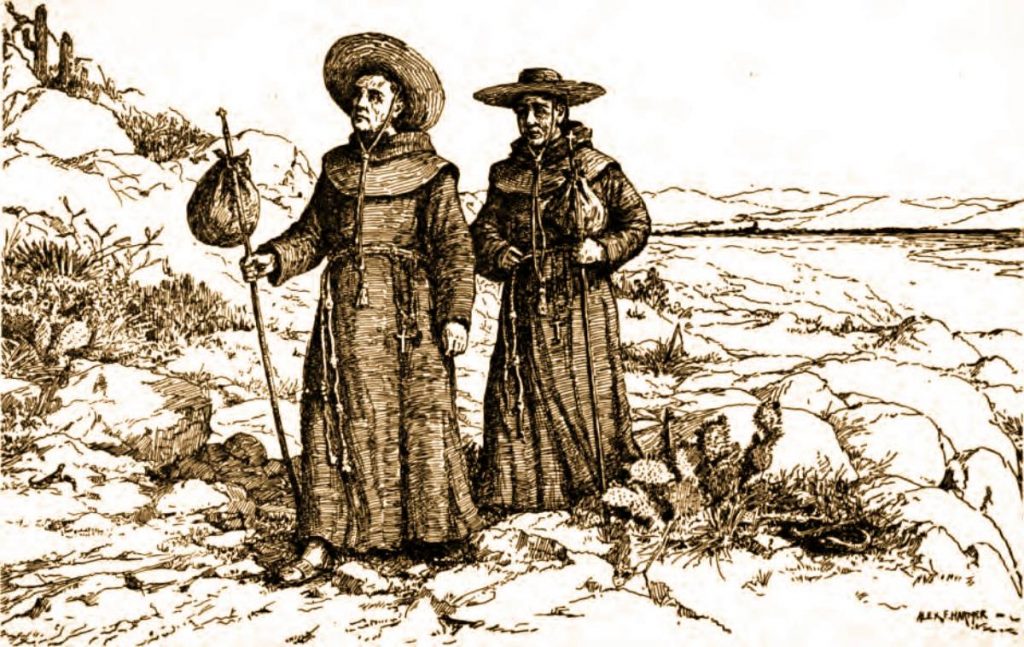
Church leadership was divided into regular clergy and the secular clergy, the former are members of a religious order who live according to a rule while the latter are priests living in the general society (Louth, 2022). In general, the secular clergy focused on administering the religious life of the Spanish colonists and the regular clergy engaged the task of evangelizing the natives (Hsia, 2017). While the secular clergy answered to the Crown, the regular clergy answered to Rome. During the reconquest, the regular clergy had become an important force in re-evangelizing territories. The first Spanish missionaries to the Americas were characterized by a vision of evangelism that emphasized “austerity, simplicity, and a preach-by-your-works ideology”. Many embraced millenarian eschatological views that believed the evangelization of the indigenous peoples of the Americas would usher in Christ’s return. Over time, the regular clergy became privileged and powerful. This generating competition with the secular clergy, who would eventually affirm their dominance during the colonial period (Hsia, 2017).
The members of the religious orders, friars, had planned to groom natives to be trained as clergy for the task of evangelization. Their strategy was to begin with the elites so that these in turn would influence the general population (Hsia, 2017). But the result was not exactly what the friars wanted, the population was evangelized but the result was a Catholicism mixed with indigenous beliefs and practices. The focal point for the work of the friars was the missionary schools where small books with pictures were used to catechize the illiterate. The instruction method of the early years has been described as “an eclectic tapestry of images, song, and oral mediums”. The missionary schools taught natives in different groups with different instruction according to their class in indigenous culture. The native elites received training preparing them to teach their fellow natives, take confession, do administrative tasks, and preach (p. 29). These native church workers and also helped teach their language to the friars. In sum, it can be said that for the native population the experience of Catholicism was predominantly native not Spanish (Hsia, 2017).
Although initially controversial, eventually the translation of Scripture and liturgical texts into native languages was embraced and thrived (Hsia, 2017). Regions where translation and distribution of sacred literature didn’t occur saw inferior church growth. Other regions saw growth spurred using printing presses to distribute literature. Indeed, “The printing press played a key role in the Counter Reformation for both Protestants and Catholics in educating their respective folds. In Spain and its American colonies, the printing press became a means to regulate the communication of the Catholic message (Hsia, 2017).
Soon however, the natives did begin producing their own Christian texts with variant versions of biblical motifs and narratives (Hsia, 2017). But the emergence of unorthodox should not necessarily be attributed to indigenous authors’ inability to understand the Christian doctrine. Nor should we assume that unorthodoxy was an intentional form of resistance or blatant rejection of Catholicism. Rather, these unconventional teachings are best understood through the lens of preexisting native practices. Numerous examples exist where the natives reinterpreted historical events or biblical stories in ways that best suited their present needs” (Hsia, 2017). The indigenous peoples of modern-day Mexico adapted their engagement with Christianity to meet personal needs and desires that were fluid. A similarity can be drawn between these attitudes and behaviors and those of many Christians in the West today. Some native Christians added things to conventional religious practice, others subtracted from it what was deemed unneeded. Yet such modifications should not seen as “defiance” or “rejection” by those who engage in them since most would still define themselves as “good Christians.” (Hsia, 2017).
References
Hsia, Ronnie. P. (2017). A companion to early modern Catholic global missions. Brill.
Religious transformations in the early modern Americas / edited by Stephanie Kirk and Sarah Rivett. (2014).
Storrs, C. (2006). The resilience of the Spanish monarchy, 1665-1700 / Christopher Storrs. Biola Library ebooks.
Yun-Casalilla, Bartolomé (2019). Iberian World Empires and the Globalization of Europe 1415–1668. Palgrave Macmillan
 davidjdawson